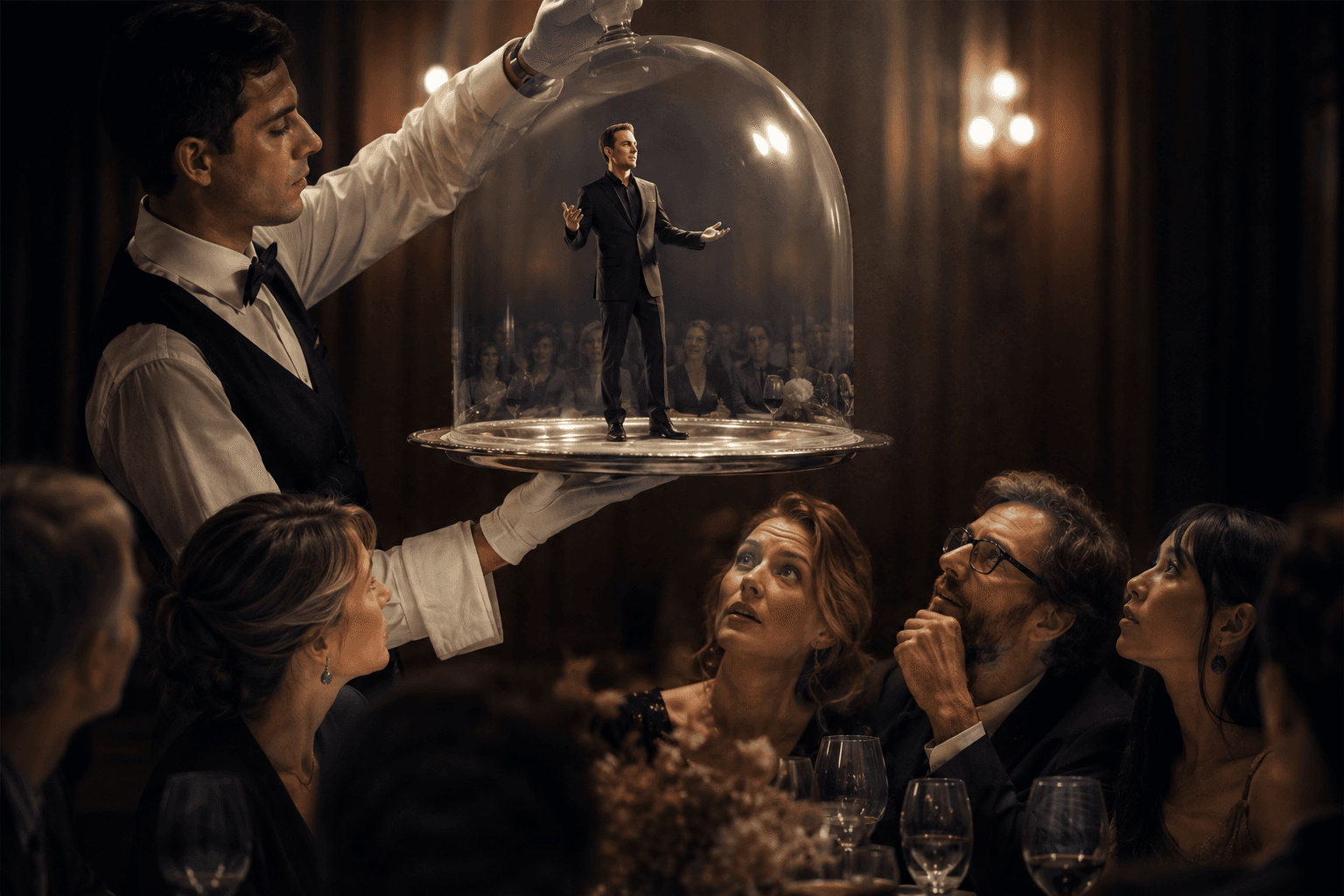
Precision in Public Communication
Every message should be crafted for the audience. The craft is mechanical, not magical. A framework for presenting under pressure, built from training speakers and years on stages.
Public communication is craftsmanship under pressure. Board room, all-hands, customer call, conference stage. The room changes. The pressure does not.
Public communication is a transaction. Their attention for your value. The craft is everything that happens between.
The audience has a small window of attention and the beginning is the make-it-or-break-it moment. The content is only as good as the person delivering it.
There is no right audience or right time. There is only translating the content to the audience. Product market fit. The speaker is the product. Only then do you win the most valuable asset, the audience's attention.
The deck is secondary. The main dish is the speaker.
The craft starts before the first slide. WIIFM (what's in it for me) is the anchor. It's all about that. Hit this and you don't have to spend the rest of the time chasing attention you already lost.
Components
The WIIFM Lock
Set one or two North Star goals tied directly to the audience's stake. Highlight them from minute one and thread them through every section. Public communication is a transaction: their attention for your value. Clarity on what they get is non-negotiable. The first minute carries the lock or you have lost the room. Every subsequent choice gets tested against it: what stays in, what goes.
The Speaker Owns It
The speaker builds the content and the deck. Anything else, the audience will know within the first minute and you have lost them. On the deck: slide titles are claims, not decoration. Generic titles ("Overview," "Background") burn real estate. Specific titles let the audience navigate when they drift. The cost of a generic headline is measured in audience drop-off. On the content: outsourcing the thinking shows up in the delivery. You can read someone else's deck. You cannot pretend it is your argument.
The Four Practices
Content, mind, body, recording. Four separate muscles, four separate practice sessions. Content is what you say. Mind is groundedness, breath, recovery from a stumble. Body is voice, hands, posture, lighting. Recording is the awkward one. You sit through it once. Cringe. Adjust. Sit through it again. Nothing teaches faster.
The Script Trap
Reading kills presence. Practice with bullets so the language emerges fresh in the room. Always leave room for improvisation. Mistakes are not bugs. They are how you become human in the room. A clean stumble, a slightly imperfect phrasing, a moment of correction: these are what make a talk memorable and relatable. The purpose is to hold attention, not to perform perfection. Performance perfection bores. Imperfection earns trust.
Engagement Mechanics
The audience does not stay engaged on its own. You hold attention deliberately. On stage: eye contact across the room, deliberate pauses, planted questions, calling on the audience, moving between zones, props if warranted. The energy is felt. When you lose them, you feel it within thirty seconds. Webinar: harder, no body language to read. Use poll questions, deliberate name-checks of attendees in the chat, micro-quizzes, breakout moments. You cannot feel the room, so you build the pulse-checks into the structure. Stage is intuition. Webinar is engineering.